

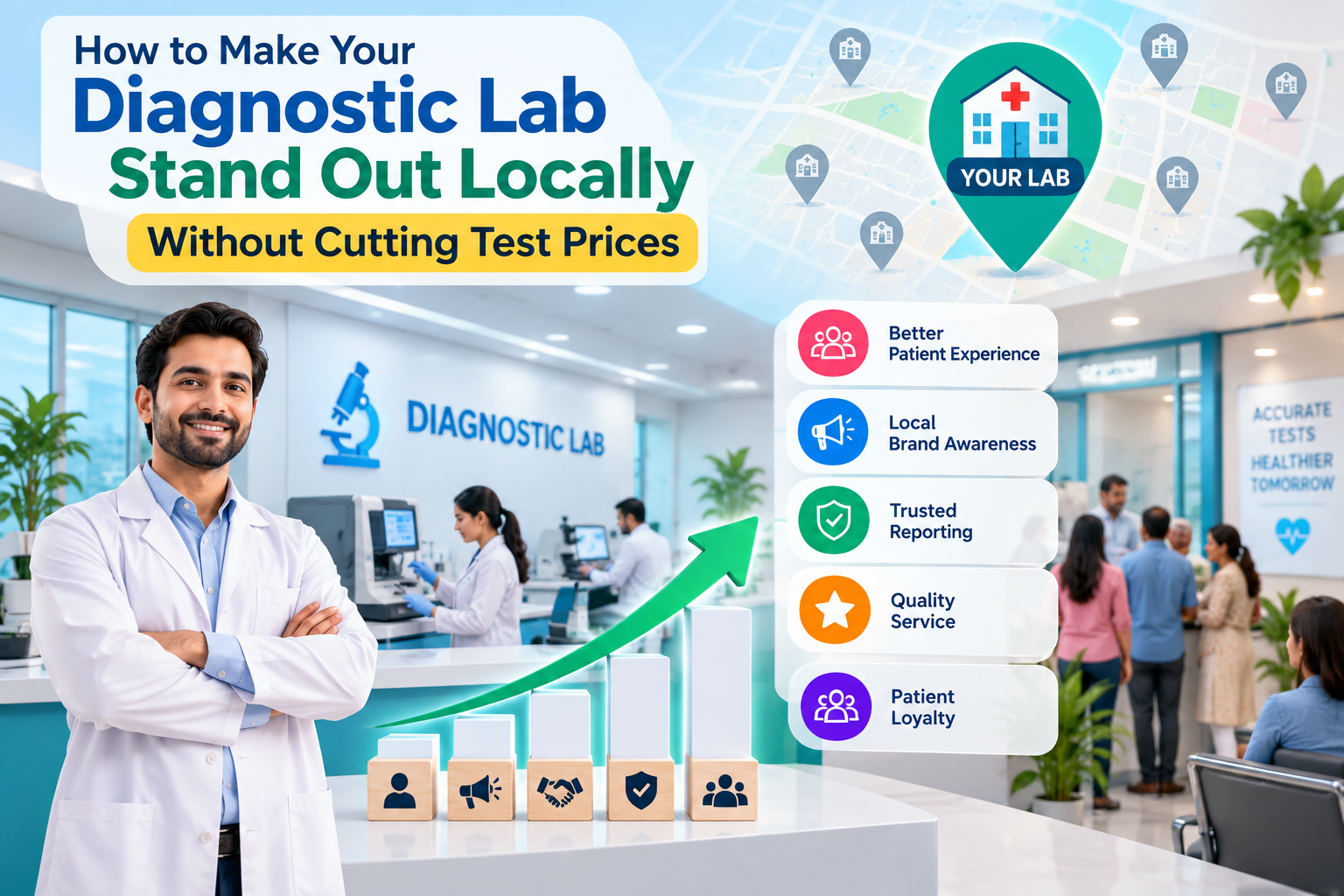
Imagine two diagnostic laboratories located on the same road. Both offer similar tests, have qualified staff, and serve the same neighbourhood. One laboratory keeps reducing its prices to attract patients, while the other focuses on better communication, a professional image, convenient service, and strong local visibility.
Which laboratory has a better chance of building long-term customer trust?
For many laboratory owners, attracting new patients is becoming a business challenge. Competing only on price can reduce profit margins and make it difficult to invest in service quality. The good news is that your laboratory can stand out in other ways.
In this guide, we will explore practical diagnostic lab marketing ideas that can help your laboratory build local recognition, improve its customer experience, and create a stronger reputation without depending on constant discounts.
1. Stop Competing Only on Price
When patients compare diagnostic laboratories, price may be one factor in their decision. However, it is not the only thing that matters.
People may also consider the laboratory’s location, opening hours, cleanliness, communication, service availability, and the clarity of its information.
If your only marketing message is “Lowest test prices,” you may attract price-sensitive customers without giving them a reason to remember your laboratory.
Instead, identify what your lab genuinely does well.
For example, your laboratory may offer:
- Convenient access from nearby residential areas.
- Clear information about test preparation.
- Friendly and professional reception staff.
- Transparent pricing and billing.
- Well-organized report delivery procedures.
- A clean and comfortable patient environment.
Choose two or three strengths that you can consistently deliver. Use them throughout your website, signage, business profile, and promotional materials.
Practical tip: Do not claim that your laboratory is the best or the fastest unless you can substantiate the claim. Specific, honest information is more useful than exaggerated advertising.
2. Make Your Laboratory Easy to Find on Google
A potential patient may search online for a diagnostic laboratory near their home or workplace. If your business information is incomplete or difficult to find, you may miss an opportunity to be considered.
Start by reviewing your Google Business Profile.
Step-by-step local visibility checklist
Step 1: Verify your business information.
Check that your laboratory’s name, address, phone number, opening hours, and website are accurate.
Step 2: Select appropriate business categories.
Use the categories that accurately describe your laboratory. Avoid adding unrelated categories simply to appear in more searches.
Step 3: Upload genuine photographs.
Use clear images of your premises, reception area, exterior signage, and other appropriate business-related details. Obtain consent before publishing photographs containing identifiable people.
Step 4: Describe your services clearly.
Explain the diagnostic services your laboratory provides. Keep the information accurate and aligned with your actual capabilities.
Step 5: Keep details updated.
Update holiday hours, contact information, and relevant service changes promptly.
Local search visibility cannot be guaranteed, but accurate and complete information helps potential customers understand where your laboratory is and how to contact you.
3. Give Your Laboratory a Recognizable Brand Identity
Think about the businesses you recognize immediately. Their branding is usually consistent across their signs, documents, websites, and promotional materials.
Your laboratory can apply the same principle.
You do not necessarily need an expensive branding campaign. Start with a recognizable logo, readable typography, a consistent colour palette, and clear contact information.
Use the same visual identity on:
- Laboratory signboards.
- Bills and invoices.
- Report letterheads.
- Business cards.
- Website pages.
- Social media posts.
- Promotional banners.
For example, if your laboratory uses blue and white branding, maintain a similar style across your website, reception signage, and printed materials.
This consistency helps people associate your visual identity with your laboratory.
Make your invoices and documents look professional
Every customer-facing document is an opportunity to reinforce your brand. A clearly designed invoice with your laboratory’s name, logo, contact details, and organized billing information looks more professional than a cluttered document.
If your current laboratory management system supports logo customization, configure it consistently across the appropriate documents.
Healthilyze has content about adding a logo to invoices for laboratory brand recognition. You can link to that article here if it is available on your website.
4. Turn Patient Experience into Your Competitive Advantage
Marketing does not begin and end with advertisements. It also includes what people experience when they visit your laboratory.
Consider a simple example.
A patient calls to ask about a test. One laboratory provides unclear instructions and an uncertain price. Another explains the preparation requirements, confirms the relevant charges, and tells the patient what to expect.
The second laboratory has created a more organized experience before the patient even arrives.
Five ways to improve the experience
Make enquiries easier. Display a working phone number and clear directions on your online profiles.
Explain preparation requirements. Provide appropriate, verified instructions for the relevant test rather than giving the same advice for every test.
Keep charges transparent. Explain the applicable fees and any additional charges before proceeding.
Communicate respectfully. Train staff to speak politely, protect patient privacy, and handle questions professionally.
Improve the waiting experience. Keep reception organized and provide realistic information about expected waiting times.
These improvements may not produce an immediate increase in patient numbers, but they can help establish trust and create a more consistent service experience.
5. Use Patient Reviews to Build Credibility
When people discover an unfamiliar laboratory, they may look at online reviews before deciding whether to contact it.
You cannot control every review, but you can create a straightforward process for collecting honest feedback and learning from it.
A simple review strategy
- Choose an appropriate point in the service journey to invite feedback.
- Share your official review link through an approved communication channel.
- Ask customers for honest feedback without pressuring them.
- Respond politely to reviews, including critical ones.
- Look for repeated complaints and take practical steps to address them.
For example, if multiple reviews mention confusion about opening hours, update your business profile and signage.
If customers frequently report difficulty contacting reception, review staffing arrangements and phone-handling procedures.
Never buy fake reviews, create reviews from staff accounts as if they were customers, or offer improper incentives for positive feedback.
Also, do not disclose patient details when responding publicly. A professional response can acknowledge a concern and invite the reviewer to contact the laboratory privately.
6. Create Social Media Content That People Actually Find Useful
Many businesses post only promotional messages. Over time, their social media pages can become repetitive and offer little value to their audience.
Your laboratory can take a more useful approach by answering common questions and sharing relevant updates.
Five content ideas for your lab
Test preparation tips: Share medically reviewed, test-specific instructions where appropriate.
Meet the team: Introduce staff or explain professional roles, with their consent.
Behind-the-scenes content: Show suitable views of the premises or explain general laboratory processes without revealing patient information or confidential procedures.
Frequently asked questions: Answer questions about opening hours, report collection, payment methods, and available services.
Community awareness: Share accurate, educational information about health awareness campaigns and appropriate preventive care.
Create a simple monthly calendar. For example, you could publish two educational posts, one service update, and one team or community post each week, adjusting the schedule to your resources.
Avoid frightening people into booking tests. Do not promise that a test will prevent a disease or make unsupported claims about diagnostic outcomes.
The purpose of your content is to help people understand your services and recognize your laboratory as a reliable source of information.
7. Build Relationships with Local Healthcare Professionals
Local professional relationships can help your laboratory become better known among relevant healthcare providers.
The goal should be to establish trust through service quality, clear communication, and professional conduct—not to pressure clinicians into referring patients.
How to start
Prepare a professional introduction. Create a concise profile explaining your laboratory’s services, location, contact details, qualifications, and relevant capabilities.
Communicate clearly. Explain your operating procedures, report-delivery arrangements, and how professional enquiries are handled.
Be realistic about turnaround times. Share timelines that your laboratory can reasonably meet and communicate delays appropriately.
Ask for service feedback. Where suitable, invite professional feedback on communication and operational processes.
Maintain ethical boundaries. Respect clinical independence and all applicable professional requirements. Avoid inducements or improper payments for patient referrals.
Strong professional relationships are built over time through dependable service and mutual respect.
8. Promote Your Services Without Constant Discounts
Discounts can have a place in a marketing plan, but frequent price reductions are not the only way to attract attention.
Instead, create promotions that clearly communicate a genuine service offering.
For example, your laboratory might:
- Publish a clear list of available tests and applicable charges.
- Promote a suitable, clearly defined test package.
- Share information about opening hours and available services.
- Create a banner for a legitimate community awareness event.
- Publish an educational post explaining a test’s purpose and preparation requirements.
For every campaign, check that the information is accurate, the offer terms are clear, and any clinical claims are properly supported.
Before launching a discount, calculate the expected costs and check whether the offer is financially sustainable.
Remember: A promotion should make your services easier to understand, not pressure people into unnecessary testing.
9. Measure Which Marketing Activities Are Working
Without tracking results, it can be difficult to know whether your marketing is helping your laboratory.
You do not need a complicated analytics system to get started. Maintain a simple monthly record of your main activities and results.
Track measures such as:
| Metric | What it helps you understand |
|---|---|
| Calls and enquiries | Whether people are contacting your lab |
| Website visits | Whether people are discovering your online content |
| Google Business Profile interactions | How people engage with your local listing |
| Review trends | What customers appreciate or want improved |
| Campaign expenditure | How much you spend on promotion |
| Enquiry-to-visit conversion | How many enquiries become actual visits |
| Customer feedback | Where your service may need improvement |
Record where enquiries originate whenever practical and appropriate. Compare results over time rather than assuming that one busy day proves a campaign worked.
Also, protect patient confidentiality. Use aggregated business information for marketing analysis and restrict access to identifiable patient information.
10. How Healthilyze Can Support Your Laboratory’s Growth
Marketing can attract attention, but your daily operations determine the experience customers receive after they contact your laboratory.
When patient records, reporting, and billing processes are organized, staff can follow a more consistent workflow and manage administrative tasks more efficiently.
Healthilyze provides laboratory management capabilities for patient records, reporting, billing, and related activities. Depending on your setup, its features can support a more organized way to manage routine laboratory work.
For example, laboratory owners can explore how digital records and billing workflows fit into their existing processes, while continuing to prioritize accurate results, qualified staff, patient privacy, and appropriate quality controls.
The important point is that software is only one part of business growth. It works best alongside professional service, ethical marketing, clear communication, and a genuine understanding of what local customers need.
Frequently Asked Questions
1. How can I attract more patients to my diagnostic lab?
Start with accurate local business information, a useful website, professional service, honest customer reviews, and educational content. Track enquiries and improve the activities that work for your laboratory.
2. Should a diagnostic lab compete by offering the lowest prices?
Not necessarily. Pricing matters, but laboratories can also differentiate themselves through convenience, clear communication, professional service, and consistent customer experience.
3. How can a small laboratory market itself on a limited budget?
Focus first on accurate business listings, a basic website, genuine review requests, useful social media posts, and professional local relationships. Prioritize activities you can maintain consistently.
4. How often should a laboratory post on social media?
Choose a schedule your team can maintain. A few useful, accurate posts each week may be more practical than publishing daily content without a clear purpose.
5. How long does diagnostic lab marketing take to show results?
There is no universal timeline. Results depend on local competition, service quality, the marketing channels used, the budget, and existing brand awareness. Monitor performance over several weeks and months rather than expecting guaranteed immediate results.
6. Can lab management software help support business growth?
It can help organize workflows such as patient record management, reporting, and billing. However, software alone does not guarantee more patients or higher revenue; results also depend on marketing, operations, service quality, and local demand.
Final Thoughts
Growing a diagnostic laboratory does not have to mean reducing prices every time a competitor launches an offer.
Start by making your laboratory easier to find, creating a recognizable brand, improving the patient experience, collecting honest feedback, and communicating the value of your services clearly.
Choose a few practical improvements, measure their results, and build on what works.
Healthilyze supports the operational side of this journey, while your laboratory’s service quality and reputation remain central to earning long-term trust.
Book a Free Demo of Healthilyze Lab Software
For More Information: www.Healthilyze.com
Follow us on Instagram: https://www.instagram.com/healthilyze/
Check Software Here: https://healthilyze.in/
READ MORE: Easy Lab Software Free Download
 Previous Post
 Next Post