

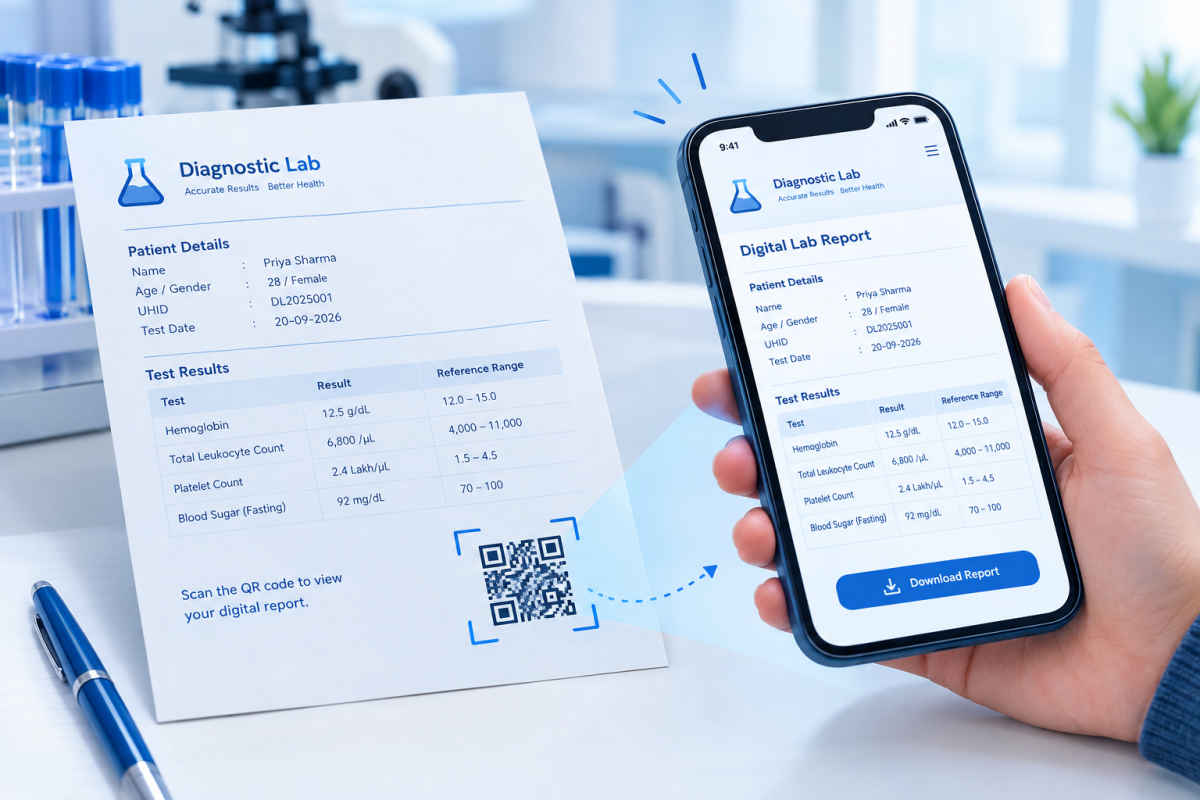
Laboratory reports are an important part of a patient’s healthcare journey. After completing a test, patients usually want to receive their reports quickly and access them whenever needed. Traditionally, laboratories provide printed reports or send report files through messaging apps or email.
As laboratories move towards digital processes, there are easier ways to provide report access. One such option is QR Code Based Reports.
With QR code technology, patients can scan a QR code using their smartphone and access their laboratory report digitally. This can make report sharing easier for laboratory staff and more convenient for patients.
What Are QR Code Based Reports?
QR Code Based Reports are laboratory reports that can be accessed through a QR code.
A QR code is a square-shaped code that can be scanned with a smartphone. After scanning, the patient can be directed to their digital laboratory report.
For example, once a patient’s test results are ready, the laboratory can generate the report and connect it with a QR code. The code can be included on the printed report or provided to the patient.
Instead of searching through old messages or contacting the laboratory again, the patient can simply scan the QR code to access the available report.
How Does QR Code Report Sharing Work?
The process can be simple for both laboratory staff and patients.
First, the patient’s information and test details are entered into the laboratory system. After the test is completed, the results are added and the laboratory report is prepared.
A QR code can then be associated with the digital report. The QR code can be added to the report or shared with the patient.
When the patient scans the code using a smartphone, they can access the digital version of the report.
This creates a simple connection between the laboratory’s report and the patient’s mobile device.
Easier Access to Laboratory Reports
Patients may need their laboratory reports after several days, weeks, or even months. Finding an old paper report can sometimes be difficult.
Digital access gives patients another convenient option.
With a QR code, patients can use their smartphone to access the report without depending completely on a physical copy. This can be particularly useful when they are travelling, visiting another doctor, or simply need to check an earlier test result.
Having an easy way to access reports can make the overall experience more convenient.
Less Dependence on Paper Reports
Printed reports are still useful and many patients prefer having a physical copy. However, paper documents can be lost, damaged, or misplaced.
QR Code Based Reports can provide a digital alternative alongside the printed report.
A laboratory can continue providing a printed report while also making the digital report accessible through a QR code. This gives patients both options without requiring the laboratory to completely change its existing reporting process.
Saves Time for Lab Staff
Laboratory staff manage many activities every day, including patient registration, test entry, result management, report preparation, billing, and report delivery.
Repeatedly sending reports or answering requests for old report copies can take additional time.
A QR-based reporting system can make report access easier by giving patients a direct way to reach their digital report.
This can help reduce some repetitive report-sharing tasks and allow staff to focus on other important laboratory work.
Convenient for Patients
One of the main advantages of QR Code Based Reports is convenience.
Most people carry a smartphone with them, so accessing a QR-based report can be simple. Patients do not always need to return to the laboratory just to collect a report.
For example, if a patient completes a test in the morning and later needs the report while at home or work, digital access can make the process easier.
The patient can scan the QR code and access the available report from their phone.
Useful for Different Laboratory Tests
QR Code Based Reports can be useful for different types of laboratory and diagnostic reports.
Depending on the laboratory’s workflow, QR-based access can be used for reports related to:
- Blood tests
- Urine tests
- Pathology tests
- Biochemistry tests
- Routine health checkups
- Diagnostic testing
- Other laboratory investigations
The purpose remains the same: providing a convenient digital way to access laboratory reports.
Connecting Printed and Digital Reports
A QR code can also help connect traditional laboratory reporting with digital reporting.
Some laboratories may not want to remove printed reports completely. Patients may still ask for physical copies for their records or doctor visits.
With a QR code included on the printed report, the same report can also provide access to its digital version.
This creates a practical combination of physical and digital reporting.
Patients can keep the printed report while having another way to access it when required.
A More Convenient Reporting Experience
Laboratory reporting is not only about preparing test results. It is also about making those results available to patients in a convenient way.
A report that can be accessed digitally can be easier to store, view, and share when needed.
QR Code Based Reports can therefore be a useful feature for laboratories that want to improve their report delivery process without making it complicated for patients.
The simple scanning process can make digital report access easier for people who are already comfortable using smartphones.
QR Code Based Reports With Healthilyze
Healthilyze helps laboratories move towards simpler and more digital workflows.
The QR Code Based Reports feature provides a convenient way to connect laboratory reports with digital access. Instead of depending only on printed reports or repeated report-sharing requests, laboratories can provide patients with a QR-based option.
For patients, this can mean easier access to their reports. For laboratory staff, it can help make report sharing more organised and convenient.
As laboratories continue adopting digital solutions, features like QR Code Based Reports can help improve everyday reporting without making the process complicated.
The idea is simple: scan the code, access the report, and keep your laboratory information easier to reach.
Frequently Asked Questions
What are QR Code Based Reports?
QR Code Based Reports allow patients to access their laboratory reports digitally by scanning a QR code with their smartphone. The QR code can be included on a printed report or provided separately.
How do patients access a report using a QR code?
Patients can scan the QR code using their smartphone camera or QR scanner. The code can then take them to the digital version of their available laboratory report.
Can QR codes be added to printed laboratory reports?
Yes. A QR code can be included on a printed laboratory report, allowing patients to keep the physical copy while also having digital access to the same report.
How can QR Code Based Reports help laboratory staff?
QR-based access can make report sharing more organised and reduce some repeated requests for report copies. Patients can access their available reports directly through the QR code.
Can QR Code Based Reports be used for different types of lab tests?
Yes. Depending on the laboratory’s system and workflow, QR-based access can be used with reports for blood tests, urine tests, pathology, biochemistry, health checkups, and other diagnostic investigations.
 Previous Post
 Next Post